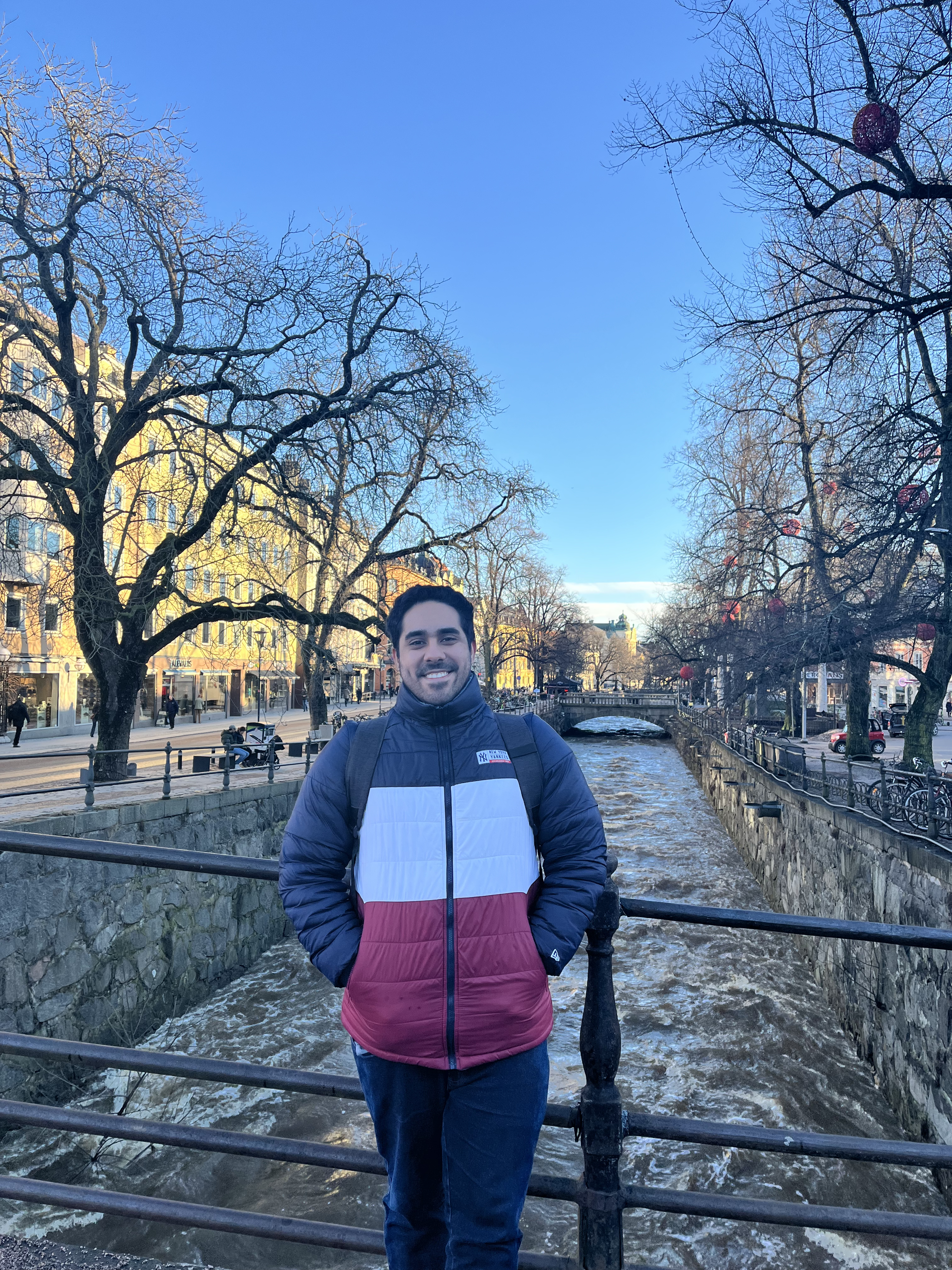
Ph.D. astronomy student at Universidade de São Paulo
About Me
Hello! My name is Arthur Silva Magalhães, and I am currently a PhD student in Astronomy at Universidade de São Paulo (USP), where I also earned my MSc degree in Astronomy in 2026, and my BSc in Physics in 2024. I work under the supervision of Prof. Jane Gregorio-Hetem, and my research interests primarily focus on star clusters, stellar formation, and the intersection of computational and observational astronomy using photometry and spectroscopy.
During my master's program, I worked on characterizing the open clusters Collinder 205 and Ruprecht 79 using infrared SOAR data collected with the Spartan IR camera.
During my exchange semester at Uppsala University (spring term of 2025), I worked under the supervision of Prof. Andreas Korn, where I analyzed VLT FLAMES-UVES data to investigate new atomic diffusion trends in the globular cluster NGC 6397. I also gained experience in differential analysis by studying the solar twin M67-1194 in the open cluster M67.
I am a proud Brazilian, and although I live in São Paulo, I was born and grew up in Belo Horizonte, the capital of Minas Gerais state. Apart from academia, I am passionate about a number of subjects and have many hobbies: In sports I am currently a rower for my univeristy, I love watching Formula 1, and also playing rugby/footbal (altough I am not good at it); In music I enjoy playing the acoustic guitar and singing (mainly brazilian music), I like listenting to rap, samba and forró; I also try to make some time for reading (mainly magical realism, philosophical fiction, and sci-fi); Most important I also really enjoy
trying new beers throughout the world and sharing them with good company!
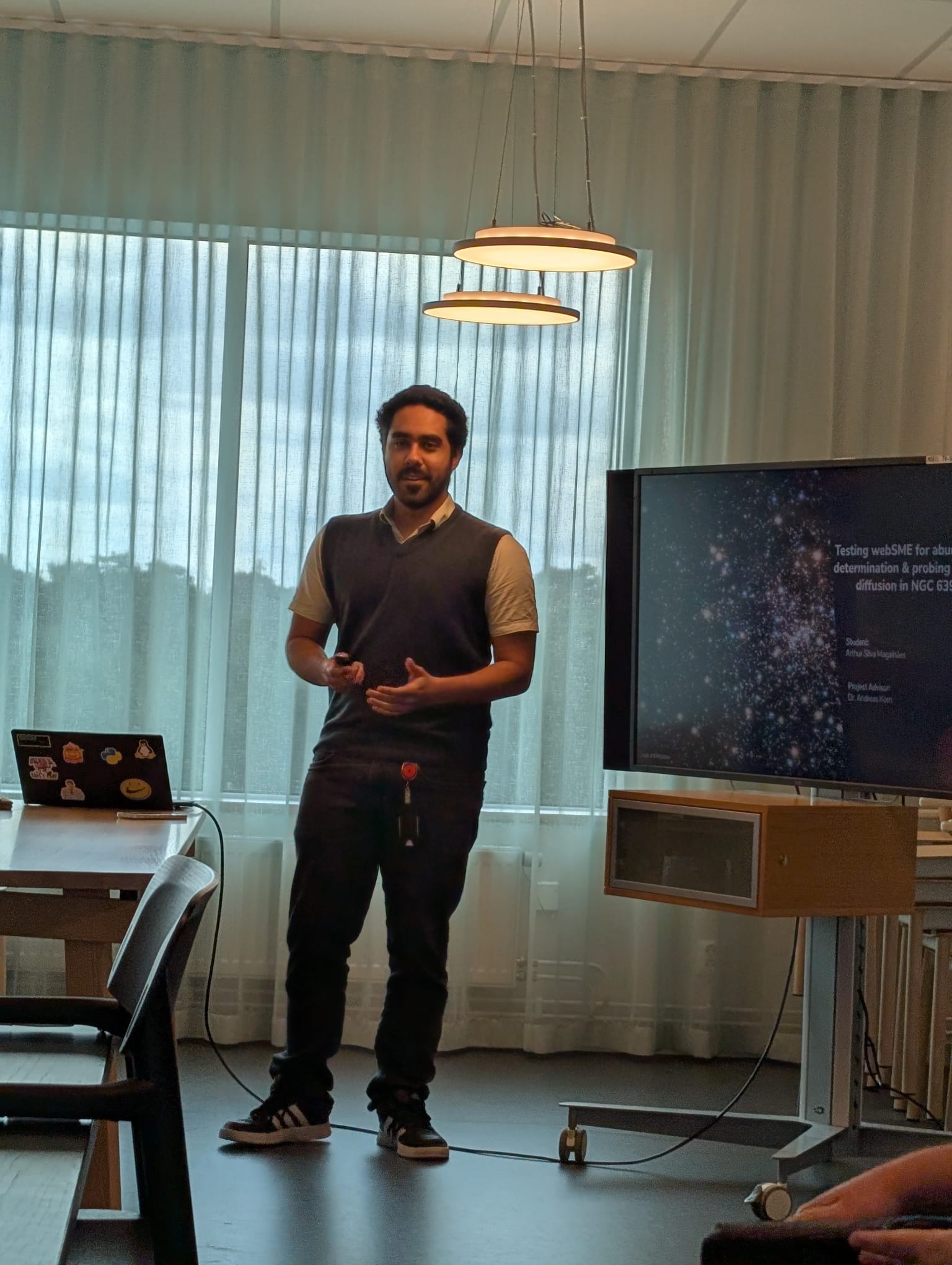
This is me presenting my research work for the Physics and Astronomy Department at Uppsala!
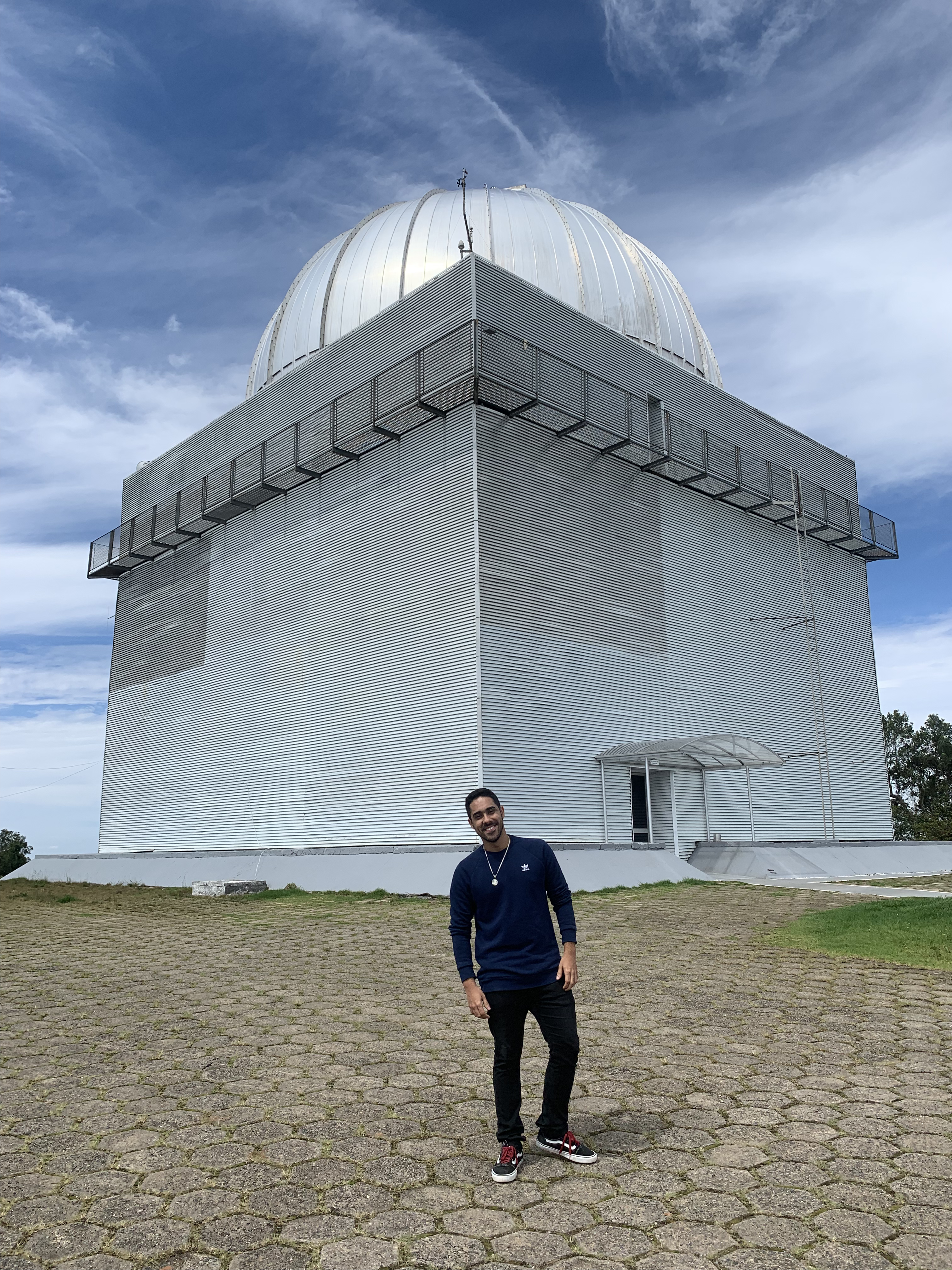
This is me in front of the biggest telescope on Brazilian soil, the 1.6 m Perkin-Elmer telescope at Pico dos Dias Observatory (OPD).
Research
My research mainly focus on star clusters (the best objects in the universe), and the intersection between observational and computational astrophysics. During my undergraduate and master's research
I worked with infrared data of young open star clusters and the analysis of its Pre-Main Sequence stars. While, during my exchange semester at Uppsala University, I worked with globular clusters and the abundance analysis of metal poor-stars.
Below you can find a summary of my research and my main interests:
Open Star Clusters
Infrared Photometry
During my Master’s research, I studied the young open clusters Collinder 205 and
Ruprecht 79 using near-infrared observations from the Spartan camera on the SOAR Telescope (in Chile!),
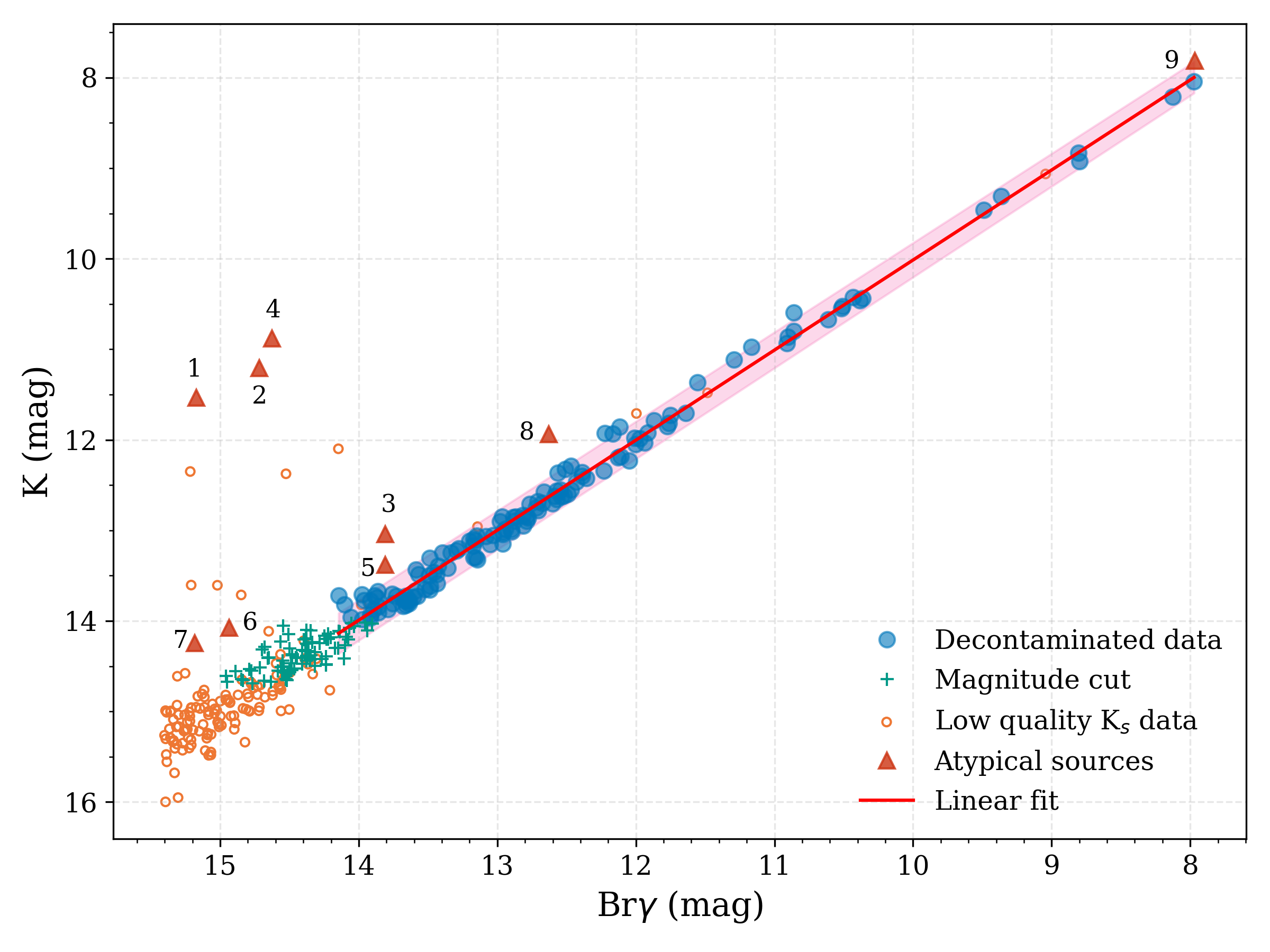
complemented by public data from the 2MASS catalog. The Spartan images revealed faint stars not detected by 2MASS and also better resolved stars close together. Therefore, through a linear transformation between the
photometric systems, I was able to refine and expanded the 2MASS dataset.
Correlation between the Kmag and the Brgamma filters for the Collinder 205 spartan sources.
Cluster Characterization
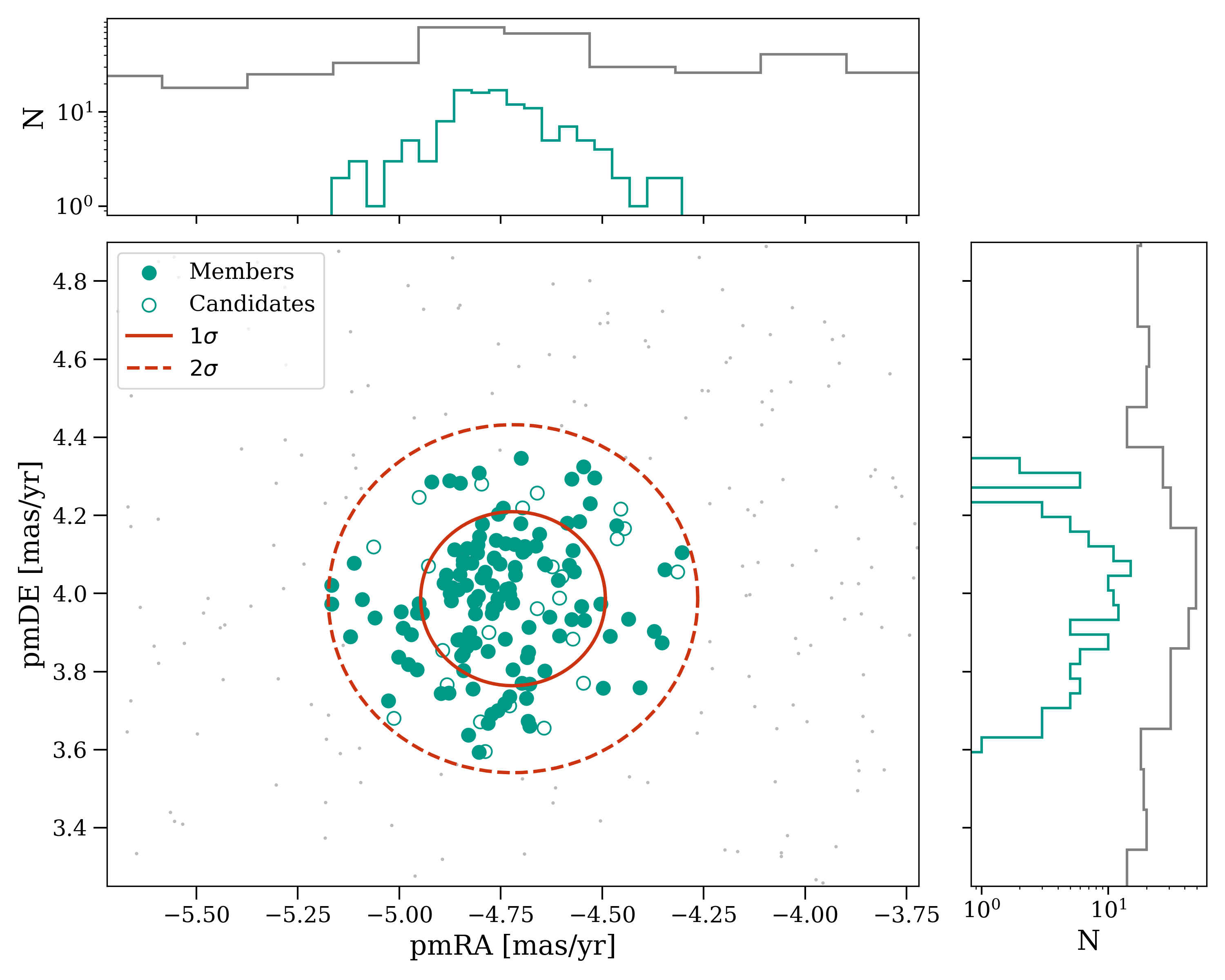
Characterizing star clusters, particularly determining which stars are true members, is a very tricky task. During my Master's reserach, I developed a methodology to constrain cluster membership by
performing a multi-dimensional analysis of proper motion, position and paralaxe space. With this results I was able to determine the clusters' mean astrophysical parameters, as well as its most probable
distance, by applying a Bayesian inference method based on Gaia DR3 parallaxes.
Vector Point Diagram of the Collinder 205 identified clusters star (green) and the field strars (gray).
Young Stellar Objects
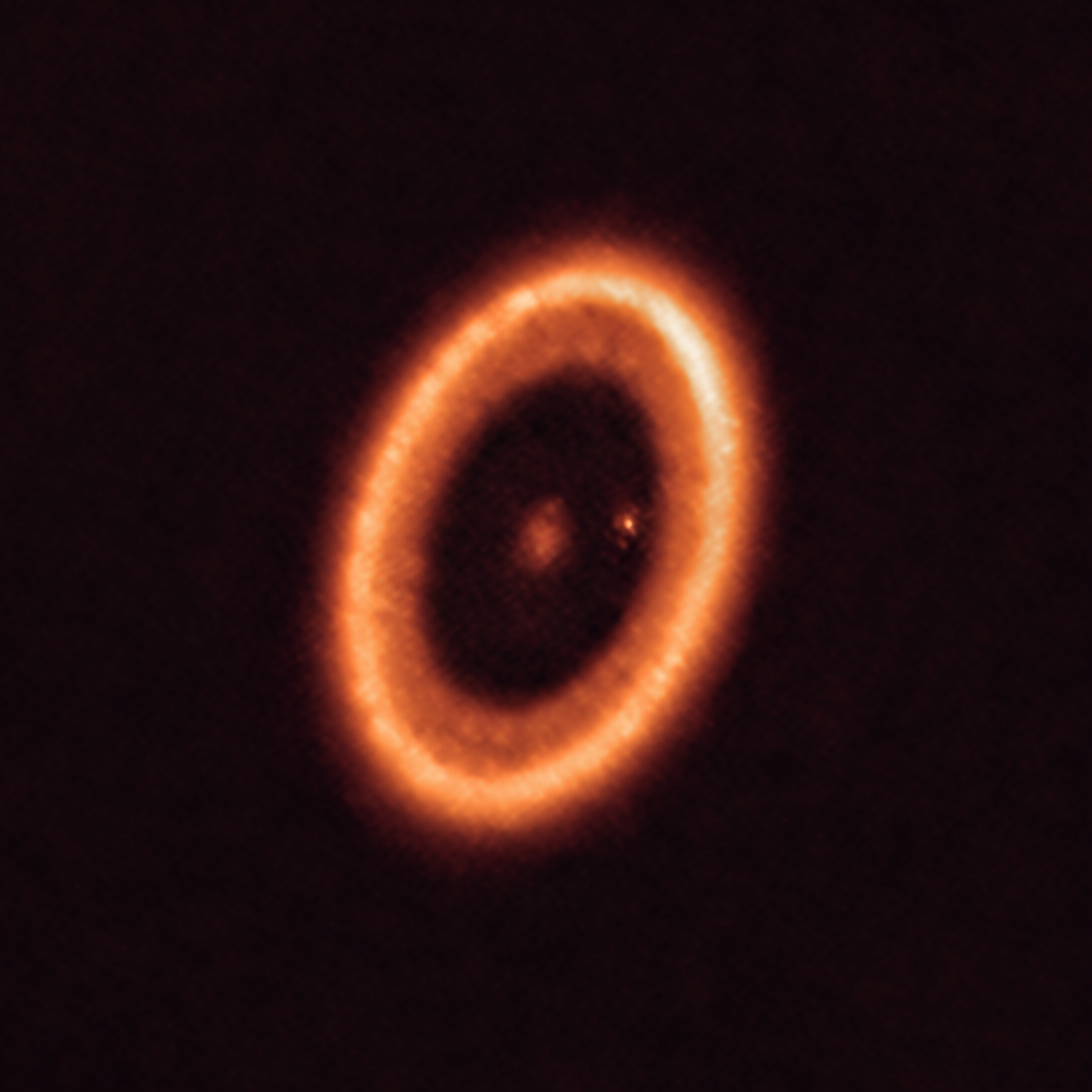
One of my major interests is the study of YSOs (Young Stellar Objects), specifically PMS (Pre-Main Sequence) stars, like the well known T Tauri stars. These stars represent the past
of our sun, and the study of its protoplanetary disk can help to constrain the formation of stellar systems and stellar formation itself! The open clusters I study are very young, containing a large number
of such stars, which I later characterize and select for further analysis.
T Tauri star PDS70 observed by ALMA. Credit:ESO.
Globular Clusters
NGC 6397
Besides open clusters, and young stellar objects, I have also worked with (the total opposite) metal-poor stars inside globular clusters. Specifically, during my time at Uppsala University, I developed two projects
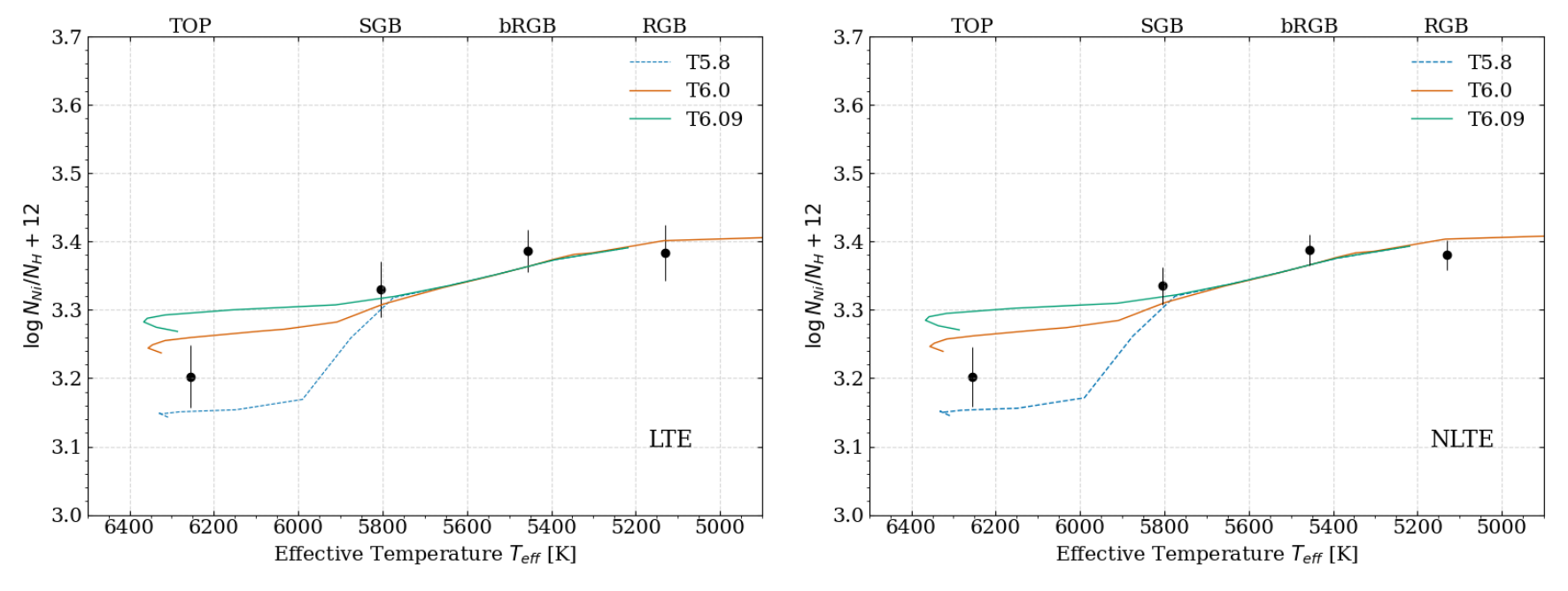
aiming to study atomic diffusion in 18 stars in different evolutionary stages, using VLT-FLAMES/UVES data of the globular cluster NGC 6397. For this, I had to learn how to work with the webMSE (spectroscopy made easy)
software, as well as with spectroscopy data. Our main result was the finding of atomic diffusion trend in Ni, both in LTE and NLTE, that was not published before. The projects results were published in the DiVA Portal, and can be found
here and here.
Ni diffusion trends found, using 18 metal-poor stars from NGC 6397.
Outreach
Independent YouTube Content Creator
I run an independent YouTube channel where I mainly talk about life in academia, astrophysics, study tips, and software tutorials.
The videos are recorded in Portuguese, and the objective is to inspire young Brazilian students to pursue scientific careers by sharing my real-life experiences, achievements, and struggles.
Check out my channel! (PT-BR only)
Astropontos & Astrobites
Astropontos is the Portuguese equivalent of Astrobites. It is an astronomy blog where graduate students can post summaries of the latest papers on arXiv Astro-ph.
The goal is to make recent astronomy developments easily accessible to undergraduate students and aspiring researchers. The website also includes posts on different topics as conference results, grad school tips, and tutorials.
I've been an active member since 2025. You can check my posts here!
I was also lucky enough to get some articles published as a guest post at Astrobites! Here is an example.
This is bold and this is strong. This is italic and this is emphasized.
This is superscript text and this is subscript text.
This is underlined and this is code: for (;;) { ... }. Finally, this is a link.
Heading Level 2
Heading Level 3
Heading Level 4
Heading Level 5
Heading Level 6
Blockquote
Fringilla nisl. Donec accumsan interdum nisi, quis tincidunt felis sagittis eget tempus euismod. Vestibulum ante ipsum primis in faucibus vestibulum. Blandit adipiscing eu felis iaculis volutpat ac adipiscing accumsan faucibus. Vestibulum ante ipsum primis in faucibus lorem ipsum dolor sit amet nullam adipiscing eu felis.
Preformatted
i = 0;

while (!deck.isInOrder()) {
    print 'Iteration ' + i;
    deck.shuffle();
    i++;
}

print 'It took ' + i + ' iterations to sort the deck.';